


You can’t solve spherical problems with flat thinking…and yet, so much of leadership, decision-making, and strategy still operates as if reality will eventually cooperate if we just simplify it enough. Straight lines. Clean answers. Either/or choices. The problem is that many of the situations we’re navigating now…in organizations, in systems, in our own lives…aren’t flat at all. They curve. They respond to pressure. They change depending on where you’re standing. And sometimes, the only way to notice that is when something quietly refuses to explain itself.
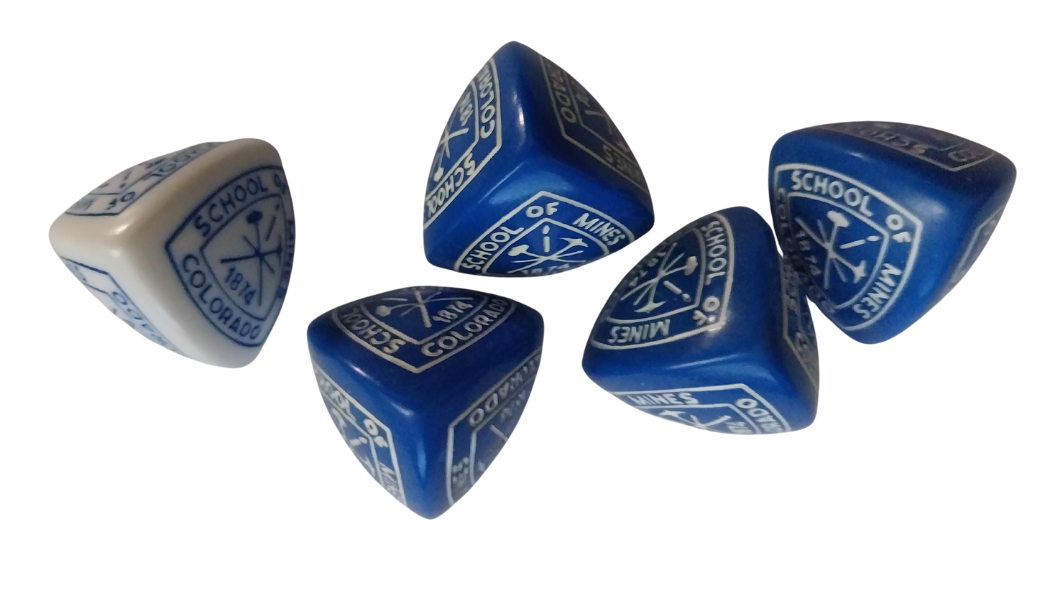
There’s a set of objects that sit on a shelf in my library…five of them…four blue spherical triangles with white writing and one white with blue writing, and for the longest time they were just there…present, noticeable, quietly curious, the kind of thing people pause at mid-conversation and ask about, not because they’re flashy, but because they don’t immediately explain themselves.
The story of how they got there isn’t symbolic at first, it’s relational. My best friend is a geophysicist and an alum of Colorado School of Mines, and like many professional communities that share both history and identity, there are gatherings from time to time…drinks, conversation, people who still speak the same language even years later. At one of those get-togethers, small giveaways were being passed around, not souvenirs in the tourist sense, but objects that signal lineage, belonging, shared training, a way of thinking that stays with you long after the formal education ends.
That’s how I ended up with the set.
I brought them home and placed them on a shelf in my library, without really interrogating why they belonged there…only that they did. And for a while, that was enough.
But as people came into the space, the questions kept surfacing, and I realized I didn’t actually know how to answer them. What are they? Why that shape? Is it a crystal? A logo? Something mathematical?
At some point, curiosity overtook assumption, and I started digging.
I’ve always been geology-adjacent…not by title, but by proximity and pull. My brother is a geologist by profession, and for as long as I can remember I’ve been drawn to crystals, to coral, to the way structure forms slowly under pressure, shaped by forces we don’t see but absolutely live inside. Marine geology, in particular, has always felt familiar to me, even without formal study…layers, compression, emergence, time doing its patient work beneath the surface.
So learning that tourmaline is the crystal associated with Colorado School of Mines landed easily. Tourmaline isn’t precious in the ornamental sense, but it’s powerful in function…a mineral known for polarity, for generating charge under pressure, for holding multiple colors within a single structure, for responding to stress rather than becoming inert or brittle. A crystal that quite literally does something when compressed.
And then there was the shape.
Not just a triangle, but a spherical triangle…a geometric form that refuses flat logic. On a sphere, angles don’t behave the way we expect them to. Lines curve. Orientation matters. Context changes the rules. This isn’t decorative geometry…it’s a way of understanding reality as it actually operates rather than how we wish it would.
At that point, the objects on my shelf
stopped being neutral.
A spherical triangle suggests a thinking posture that doesn’t rush toward certainty, that doesn’t collapse complexity into binaries just because they’re easier to manage. Three faces, none dominant, each necessary, each holding tension with the others. Curved edges that won’t allow you to pretend the world is flat simply because straight lines feel more controllable.
It makes sense that a school grounded in geoscience and engineering would choose this as its emblem. The Earth doesn’t operate in either/or terms. Systems don’t reward premature clarity. Pressure isn’t an interruption to be avoided…it’s information.
And that’s where this quietly crossed into my work.
So much leadership strain comes from trying to solve spherical problems with flat thinking…demanding linear answers from curved realities, forcing decisions into false binaries, rushing to action before we’ve properly oriented ourselves to where we’re standing.
Alignment isn’t about choosing a side…it’s about holding the shape long enough for something honest to emerge.
People. Process. Purpose. Identity. Strategy. Reality. Inner truth. Outer systems. Consequences that take time to reveal themselves.
Tourmaline doesn’t become less itself under pressure…
it becomes more responsive.
The five forms still sit on my shelf. I don’t reach for them to explain anything. But they’ve become a physical reminder that clarity isn’t something you force…it’s something that shows up when you stop flattening what’s trying to teach you.
Strategic Reflection Prompt
Where in your leadership or life are you insisting on straight lines…when the situation is asking you to think in curves?
About Giselle
I’m Giselle Hudson, a Business Diagnostic Specialist for leaders under pressure. I work with leaders managing teams, businesses, or nonprofits to bring clarity to situations where things aren’t working as expected — and it’s not fully clear why. I examine how decisions are being made, so you’re not reinforcing what’s not working, but moving forward with clear direction.
If you are carrying a decision that affects income, reputation, or organizational stability, don’t move it forward alone.
 Giselle Hudson | Pre-Decision Advisory for Leaders Under Pressure