

The Woman Whose Inside Matches
Her Outside
Lorraine Toussaint on truth, imagination, spirituality,
and becoming fully herself.
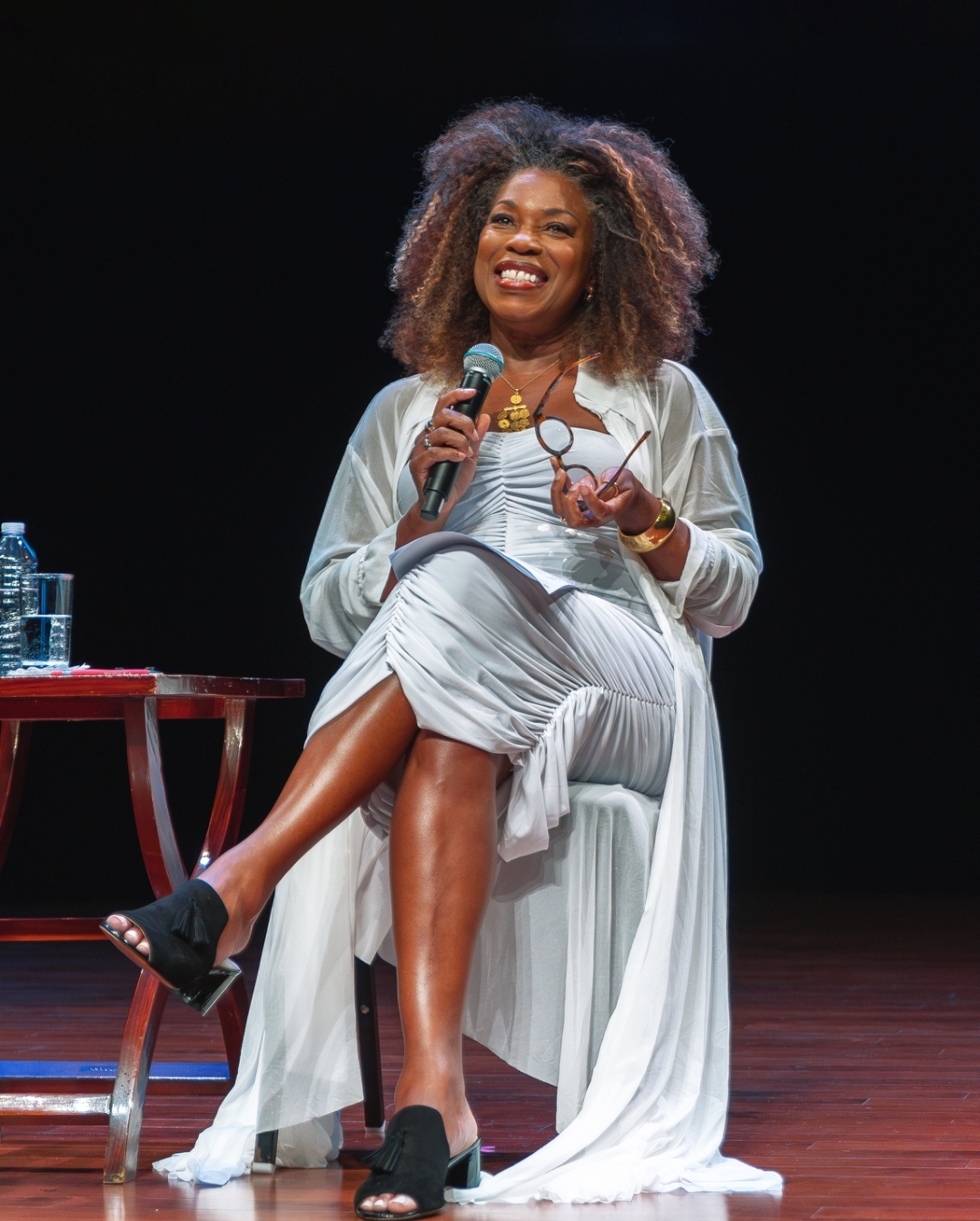
Editor’s Note:
I recorded this conversation with Lorraine Toussaint in Barbados in June 2025. At the time, I thought I was interviewing an acclaimed actress about her craft and career. More than a year later, revisiting the transcript, I realized the conversation was about something far deeper: truth, spirituality, grief, imagination, and what it means to live in alignment. The Spotlight you are about to read is not the one I would have written then. It is the one I can write now.
I sat down with Lorraine Toussaint in Barbados during the Cross Continental Forum expecting to talk about acting, career longevity, and the craft that has made her one of the most respected performers of her generation. What emerged instead was a conversation about truth, suffering, imagination, spirituality, and the lifelong work of becoming fully oneself.
Years ago, Lorraine described acting as a spiritual practice. When I mentioned the quote, she laughed, almost surprised by her own words.
“I said that?!!”
Then, after a brief pause, she explained exactly why she still believes it.
For Lorraine, artistry is inseparable from something larger than performance.
Artists, she reflected, spend their lives attempting to tell a level of truth that comes from somewhere deeper than personality, ambition, or recognition. The work requires access to a place beyond ego. A place where the self becomes less important than the message moving through it.
“There is no way to be an artist without touching God,” she told me.
The statement was offered without spectacle or performance. It arrived with the calm certainty of someone who has spent decades testing that idea against experience.
Lorraine sees herself less as the creator of the work and more as its conduit. Her responsibility is to keep the instrument clean: physically, emotionally, psychologically, and spiritually. The task is not to control the process but to create the conditions for something larger to move through her with as little interference as possible.
As she spoke, I found myself thinking about writing. Those moments when a sentence arrives before you consciously know where it came from. The times when the work seems to be leading rather than following. Lorraine smiled immediately.
“It starts to write you.”
Anyone who has ever created something meaningful knows exactly what she means.
The deepest work rarely feels manufactured. It feels discovered. It emerges from somewhere beyond effort and planning. It asks for preparation, certainly, but it also asks for surrender.
Yet surrender, as Lorraine would later reveal, is not without cost.
When I asked how she chooses roles at this stage of her career, I expected an answer involving scripts, directors, opportunities, or creative challenges. Instead, she offered a different measure entirely.
“I choose the ones that scare me.”
When Lorraine spoke about being scared, she wasn’t referring to being afraid. There was no fear of failure in her answer, nor was she talking about professional risk. The roles that call to her are the ones that demand something deeper. They require a greater level of truth. They ask how much of her humanity she is willing to place on the table in service of the story.
As she described it, every meaningful role asks the same question: How much of yourself are you willing to reveal? How much truth are you willing to tell? How naked are you willing to be in front of another human being?
Most people spend their lives hiding aspects
of themselves.
Great actors do the opposite. They move toward what others avoid. They expose what others conceal. They offer their humanity, including the uncomfortable parts, in service of helping others see their own.
Listening to Lorraine describe her process, it became clear that what she calls acting bears little resemblance to what most people imagine.
Great actors do not pretend, she explained. The body and psyche do not distinguish between what is real and what is imagined. The grief is experienced. The heartbreak is experienced. The betrayal, loss, rage, and longing are experienced. The audience sees a performance. The actor lives the experience.
That reality carries a cost.
Some roles leave physical marks. Others leave emotional ones. Lorraine spoke candidly about how long it took to release certain characters after the work ended. Some stayed with her for months…others lingered even longer. To fully inhabit a character requires granting parts of yourself permission to emerge, including aspects most people spend their lives suppressing.
And perhaps that willingness to enter difficult emotional territory began much earlier than either of us anticipated.
As our conversation shifted toward her childhood in Trinidad, the celebrated actress seemed to disappear. In her place was a little girl carrying a grief too large for her years.
When Lorraine was young, her mother left for America, leaving her in the care of her grandmother. There was little explanation. Little acknowledgment of the loss. In those days, she reflected, adults rarely considered the emotional lives of children with the seriousness they deserved.
The grief was overwhelming.
She struggled in school. Her concentration disappeared. The violin, one of the few things she truly loved, was taken away because the adults around her misinterpreted her suffering. What they saw as poor performance was, in reality, heartbreak.
Looking back now, Lorraine recognizes those
years differently.
Unable to find safety in the world around her, she began retreating inward. Deeper and deeper inward…into imagination…into possibility…into an internal world vast enough to hold everything the external world could not.
What was once survival became something
else entirely.
She described discovering a place within herself that felt infinite. A place where she could continue going deeper, discovering new layers of awareness, possibility, and knowing. What felt like isolation at the time became the beginning of a spiritual journey. The external world felt uncertain and unsafe. The internal world offered endless expansion.
And somewhere within that interior landscape, she developed an unshakable certainty.
This was not a plan, nor was it a roadmap. She wouldn’t say that it was clear vision either. What it was…was a knowing. Yes, a knowing that she was more than her circumstances…more than her grief…and more than the pain she was experiencing in that moment.
As she spoke, I felt tears gathering unexpectedly.
Partly because her story echoed my own. When I was young, my mother left to study abroad, and like Lorraine, I struggled to understand the absence. Like Lorraine, I experienced the confusion and grief that comes when adults fail to recognize the emotional realities children carry. But more than that, I recognized the feeling she was describing.
That quiet awareness that your life is meant for something larger than your present reality.
Not larger in status but larger in service and purpose. The kind of knowing that never quite leaves you alone.
As our conversation continued, I asked Lorraine about something many people overlook when discussing success: design.
Looking at her life now, her body of work, her legacy, and the rhythm she has created, I wondered how much of it had been intentional and how much had been surrender.
Her answer resisted the neat distinction.
There was intention, certainly. Not the rigid kind that maps every step in advance, but the quieter kind that remains faithful to an inner direction. She spoke about envisioning a larger life from an early age, yet much of what followed required her to remain open to what could not be predicted or controlled.
Listening to her, it occurred to me that some lives are built less through force and more through participation. They are shaped by showing up, paying attention, and responding when the next invitation appears.
Lorraine’s journey seemed to be neither entirely designed nor entirely surrendered. It was a conversation between the two.
By the time I asked my final question, the conversation had travelled far beyond acting.
We had explored artistry, spirituality, grief, imagination, identity, and purpose. It felt fitting then to ask about alignment.
What does alignment look like now?
Lorraine didn’t hesitate.
“Alignment for me looks like my insides fully reflecting the outside and the outside fully reflecting the inside.”
The simplicity of the answer belied its depth.
No divided self. No performance. No separation between who she is privately and who she appears to be publicly. No gap between belief and behaviour. No distinction between the woman and the work.
Yet for all the depth and spirituality that characterized our conversation, some of my favourite moments were unexpectedly ordinary.
When I asked whether her Caribbean upbringing still showed up in her life after decades abroad, Lorraine didn’t talk about identity politics or cultural theory.
She talked about tea. Proper tea.
Tea made with boiling water, not merely hot water. Tea accompanied by evaporated milk, which she travels with because, in her view, there are some compromises that simply aren’t worth making.
She spoke about gardening, growing food, planting fruit trees, and memories of picking sorrel, peppers, and plums with her grandmother. She spoke about strong women, describing herself as coming from generations of what she called “Amazonian women.” She laughed about still caring far too much about table manners and the small habits that remain long after geography changes.
In that moment, the celebrated actress disappeared again and the Trinidadian woman emerged.
It struck me that alignment often reveals itself in ordinary places.
The rituals we refuse to abandon and the traditions that continue to shape us long after we’ve left home. Perhaps that, too, is a form of remembering who we are.
Lorraine Toussaint has built an extraordinary career.
Yet what stayed with me most was not the actress. It was the woman. A woman comfortable enough in her own skin to stop performing even while making a living from performance.
A woman whose spirituality informs her artistry, whose artistry reflects her humanity, and whose humanity remains deeply connected to the little girl who learned long ago that when the world becomes too small, the soul knows how to expand.
Perhaps that is what alignment ultimately is. The inside and outside becoming one.

