
Today’s 𝗦𝘁𝗿𝗮𝘁𝗲𝗴𝗶𝗰 𝗔𝗹𝗶𝗴𝗻𝗺𝗲𝗻𝘁 𝗝𝗼𝘂𝗿𝗻𝗮𝗹 𝗽𝗼𝘀𝘁 in two sentences.
Hannah Elias accumulated considerable wealth in an America where race and gender restricted economic opportunity, only to find her fortune subjected to intense legal and public scrutiny. Her story invites us to examine the unwritten rules governing our own ecosystems, particularly those that determine who gains access to opportunities and whose success is considered legitimate.
When I first came across the story of Hannah Elias, I was surprised to discover that she was Black. Here in Trinidad and Tobago, I generally associate the surname Elias with our Syrian-Lebanese community, so naturally, I wanted to know more about her family background.
Elias was her birth surname. Born in Philadelphia around 1865, she was one of nine children of parents of mixed racial ancestry. Her father, Charles Elias, reportedly operated a catering business. The surname itself has biblical origins and is found across numerous cultures. I could find no documented connection between her family and the Middle East.
What proved even more intriguing was her journey to wealth and the circumstances under which she was eventually called upon to defend it.
When Wealth Was Put on Trial
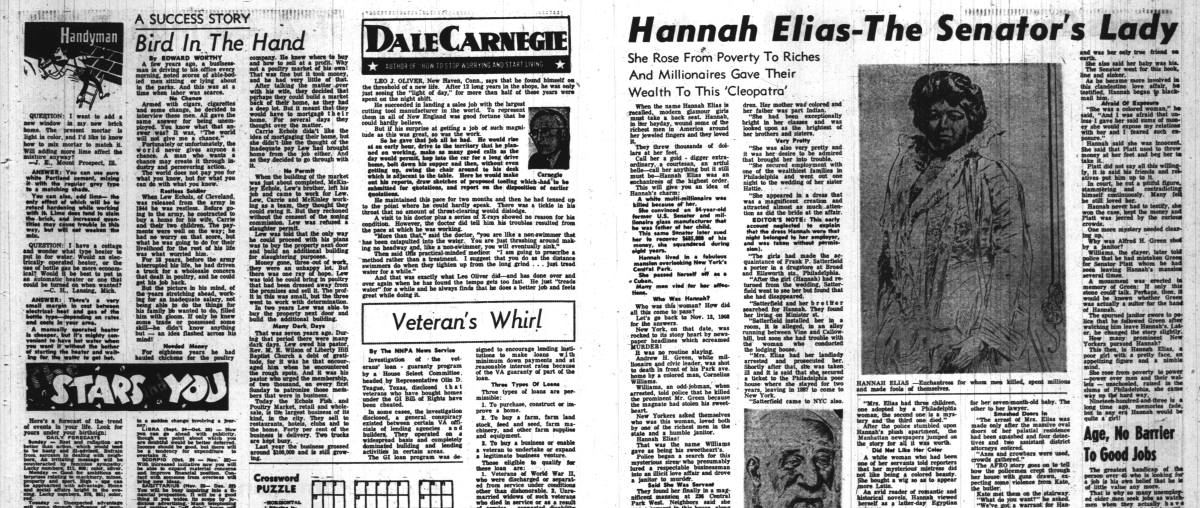
By 1904, Hannah Elias was living in a five-story mansion overlooking Central Park in New York. She owned substantial property and had accumulated considerable financial assets in an America where race and gender severely restricted economic opportunity.
Elias had worked as a domestic servant and a sex worker before becoming a boarding-house proprietor and real estate investor. Her long-standing relationship with wealthy white businessman John Rufus Platt gave her access to substantial capital.
In 1904, Platt sought to recover $685,385 from Elias, alleging that she had obtained the money through blackmail, intimidation and coercion.
Newspapers sensationalized the story, drawing considerable attention to her race, background and the nature of their relationship. Biographical accounts suggest that some of her wealthy neighbors had previously assumed she was Cuban or East Indian.
During the court proceedings, Platt acknowledged that he had given her money voluntarily. His allegations were not substantiated, and the civil complaint was dismissed. On November 20, 1906, the New York Court of Appeals upheld that decision.
The legal outcome did not however, change public perceptions of Elias. Legal entitlement and social acceptance are two different things.
Resourcefulness Within Restrictive Systems
It would be misleading to describe Elias as an entirely self-made millionaire. Her relationship with Platt was instrumental in giving her access to capital. Equally, reducing her financial achievements to that relationship overlooks what she subsequently did with the resources available to her.
Elias invested in real estate and became involved in Harlem’s developing property market during a period when Black New Yorkers faced significant housing discrimination.
We frequently celebrate entrepreneurs for recognizing opportunities, leveraging relationships and converting available resources into income-producing assets. Yet our assessment of those activities can vary considerably depending on who is doing them and how they acquired their initial resources.
This does not mean that unconventional routes to wealth should escape ethical scrutiny. It does mean that such scrutiny should be informed by evidence and applied consistently.
Economic Power and Social Acceptance
Wealth can purchase property, provide financial independence and expand the choices available to an individual. It cannot necessarily secure acceptance within the institutions and social circles traditionally associated with wealth.
Elias could afford to live among wealthy New Yorkers, yet her presence there became a source of public fascination once her identity and circumstances were revealed.
Her wealth had enabled her to enter a social environment from which she might otherwise have been excluded. What it had not secured was the same degree of acceptance afforded to others of comparable wealth.
The Rules Nobody Writes Down
Organizations and societies operate through both formal and informal rules. The formal ones are generally easier to identify. The informal ones are communicated through patterns of acceptance, exclusion, reward and recognition.
An organization may have clearly defined promotion criteria, yet employees who satisfy those requirements may discover that advancement depends on personal relationships or an unwritten understanding of what leadership should look like.
Similarly, an entrepreneur may satisfy every formal requirement for entering a market while finding that established networks influence access to customers, capital and commercial opportunities.
Understanding an ecosystem requires examining not only how it is officially supposed to operate, but also the relationships, expectations and power dynamics that influence how it actually operates.
Hannah Elias’s story brings together questions about access to capital, resourcefulness, personal agency, social mobility and institutional power. It invites us to examine who has the authority to determine which paths to success are acceptable, whose achievements deserve recognition and whether those judgements are applied consistently.
A system’s formal rules may tell us what is permitted, but its unwritten rules often reveal who is expected to succeed and whose success it is prepared to accept.
Strategic Reflection Prompt
What unwritten rules operate within your professional or organizational ecosystem, and how do they influence who gains access to opportunities, whose achievements are recognized and whose success is questioned?
References & Further Reading
- Hannah Elias | Wander Women Project
- Hannah Elias: Biographical and Family Background | Includes accounts of her father’s catering business
- Elias: Surname Meaning and Family History | FamilySearch
- Platt v. Elias (1905) | New York Supreme Court, Appellate Division
- Platt v. Elias (1906) | New York Court of Appeals
- Fighting Extreme Discrimination, They Became America’s First Black Millionaires | The Washington Post, review of Shomari Wills’s Black Fortunes
I’m Giselle Hudson, The Pre-Fixer™.
For nearly three decades, I’ve worked with business owners and leaders across the Caribbean who carry important decisions largely on their own, often when problems keep returning, solutions fall short, or implementation stalls.
When I ask business owners what problem they can’t seem to solve, the answer is usually “people.” So I ask them to tell me more, because people and businesses are rarely as simple as they first appear.
I help them understand what’s really causing the problem before they spend more trying to fix it. And where needed, I help design the solution and guide their teams to put it into practice.
Get Clarity before the Fix.
What are you trying to make sense of right now?