


I first came across Erin French in an episode of Be My Guest with Ina Garten, and what stayed with me wasn’t just the food or even the setting, but the way Ina Garten spoke about Erin’s restaurant. Almost like it existed slightly outside of the usual restaurant world, tucked into a quiet town in Maine and operating on its own terms.
I hadn’t heard of The Lost Kitchen before that, which made me even more curious. I didn’t hear about it from a “top restaurant lists” or through some heavily marketed experiences, but from a conversation that carried a certain kind of respect for what had been built there.
As I went back and read more about Erin French, the story of how the restaurant came to be, started to fill in around that first impression, and it didn’t follow a predictable trajectory.
She didn’t arrive through the traditional restaurant pipeline or scale her way up through increasingly visible kitchens. Instead, there was a stretch of time where she was cooking out of her apartment, hosting small dinners, rebuilding her life in the process, and gradually shaping something that felt grounded in a very specific way of working.
When she eventually opened the restaurant in a restored mill in Freedom, Maine, it carried that same sensibility forward: – intimate, personal, and structured around a fixed number of guests rather than an open flow of traffic.
That intimacy, though, is where the tension began to show up, because as word spread and demand increased, the mechanics of simply managing reservations started to press against the way the restaurant was designed to operate.
What had once been a straightforward administrative task began to take on a different weight, with phones ringing constantly, inboxes filling faster than they could be handled, and the process of deciding who gets a table becoming something that required ongoing attention in a way that pulled focus away from the restaurant experience itself.
It’s at that point that the shift happened.
It didn’t read as a polished strategic move so much as a response to a constraint that needed to be resolved in a way that didn’t compromise the rest of what had been built.
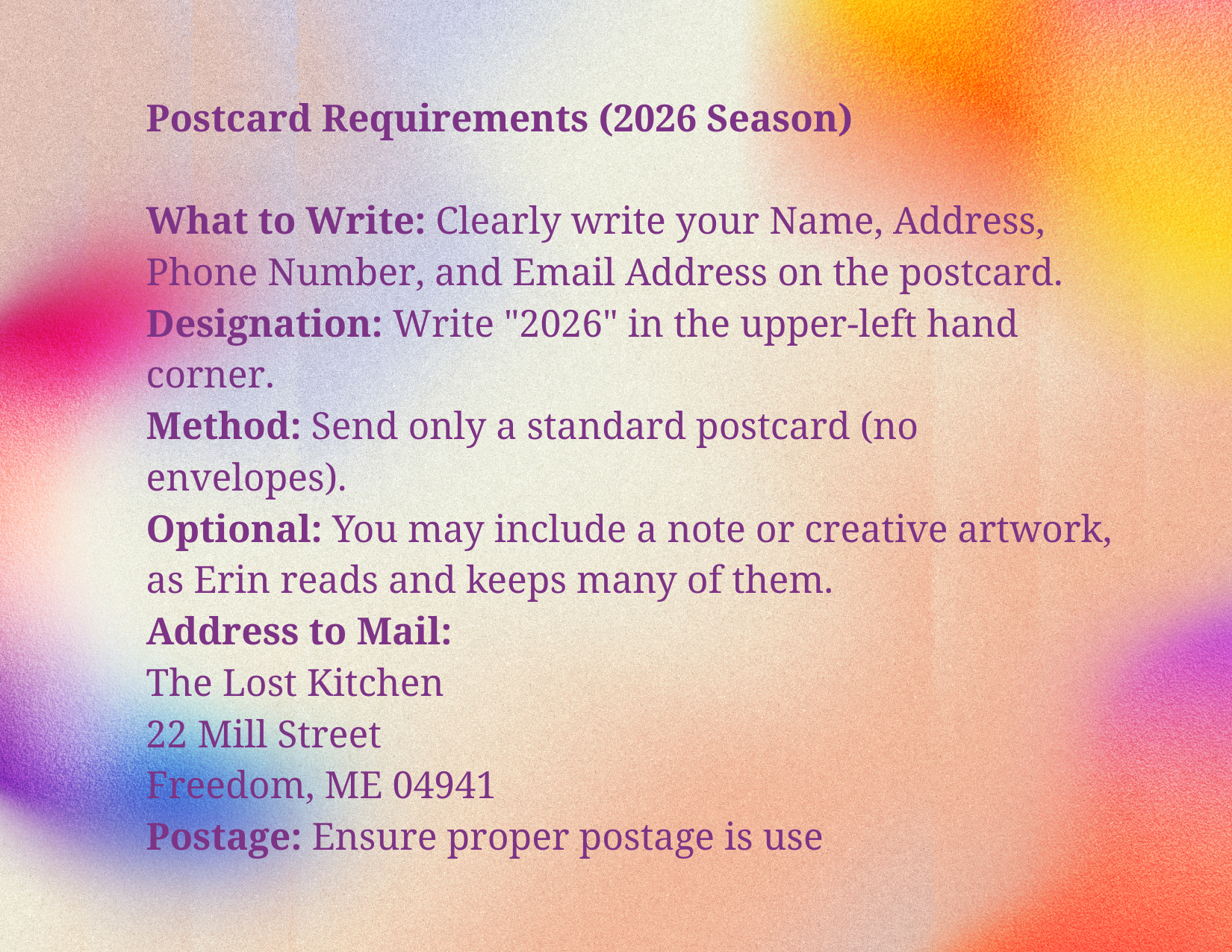
Instead of layering in more systems to manage the volume or trying to optimize for speed and access, she moved in a different direction entirely, creating the postcard lottery that now defines how people enter the experience.
You write, you send, and then you wait, knowing that the outcome is uncertain and that the process itself requires a level of participation that most reservation systems have long since removed.
What’s striking is how that decision restructured the meaning of something that is usually treated as purely functional.
Making a reservation is typically a transactional step, something you complete as quickly as possible on your way to the “real” experience, and yet here, it becomes part of the experience itself, shaping how people engage long before they arrive. The act of writing a postcard, deciding what to include, and sending it off into a process that doesn’t guarantee a result introduces a different kind of attention, one that doesn’t align with immediacy but with intention.
I keep thinking about how easily that moment could have been handled in a more conventional way, especially given the level of demand.
Most businesses, when faced with that kind of pressure, move toward systems that increase efficiency, reduce friction, and allow more people to pass through with less effort. And in many contexts, that makes sense. But here, the adjustment didn’t move in that direction, and instead of reducing engagement, it seemed to deepen it, because the process began to reflect the experience it was leading into rather than sitting outside of it as a neutral step.
It doesn’t feel like the goal was to make things harder for the sake of it, or to create exclusivity as a signal of value, but rather to resolve a real operational challenge in a way that stayed consistent with how the restaurant was meant to be experienced.
The result is that something as mundane as booking a table carries a different weight, not because it has been artificially elevated, but because it has been reconsidered in context, with attention to what it contributes rather than how quickly it can be completed.
And sitting with that, it becomes harder to look at the quieter parts of a business as simply administrative, because they are often the first point at which someone encounters how you work, even if they don’t consciously register it that way.
The question that starts to emerge is less about whether to simplify or complicate those moments, and more about whether they are aligned with the experience you are actually creating, or quietly pulling in a different direction.
Strategic Reflection Prompt:
Where in your business have you defaulted to efficiency in moments that shape first contact, without examining whether that efficiency is reinforcing or diluting the experience you are trying to create?
About Giselle
For nearly three decades, I’ve worked with leaders across the Caribbean facing problems that keep returning, solutions that haven’t delivered the expected results, or changes that prove difficult to implement.
When I ask business owners what problem they can’t seem to solve, the answer is usually “people.”
So I ask them to tell me more, because people and businesses are rarely as simple as they first appear.
I help them understand what’s really causing the problem before they spend more money trying to fix it. And where needed, I help design an appropriate solution and work with their teams to implement it effectively.
What are you trying to make sense of right now?

